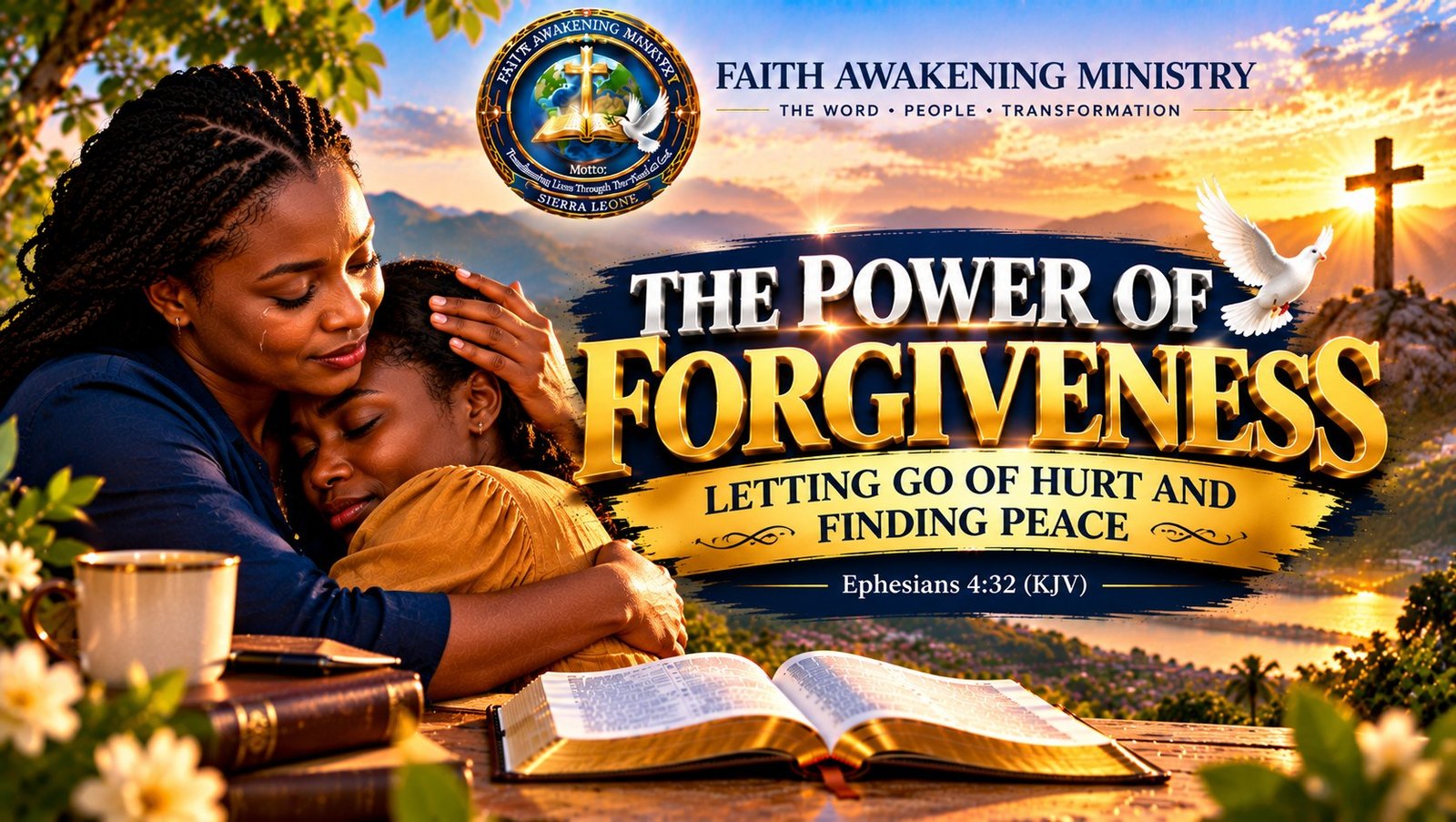
THE POWER OF FORGIVENESS: LETTING GO OF HURT AND FINDING PEACE
Key Scripture: Ephesians 4:32 (KJV)
"And be ye kind one to another, tenderhearted, forgiving one another, even as God for Christ's sake hath forgiven you."
Introduction: When Someone Hurts You
Have you ever been hurt by someone you trusted?
Perhaps it was a friend who betrayed your confidence, a family member who disappointed you, a spouse who said something painful, or someone who treated you unfairly despite everything you did for them.
Sometimes, the deepest wounds do not come from strangers. They come from people we love, people we support, and people we never expected to hurt us.
You may have tried to forget what happened, but the memory keeps returning.
You remember the words they spoke. You remember how they treated you. You remember the disappointment and the tears.
Perhaps you have even asked yourself:
"How can I forgive someone who has caused me so much pain?"
"Does forgiving someone mean I must allow them to hurt me again?"
"What if the person who hurt me has never apologised?"
These are difficult questions, and the Bible offers important guidance.
In Ephesians 4:32, believers are encouraged to forgive one another, remembering the forgiveness God has shown us through Jesus Christ.
Forgiveness is an important part of Christian living. However, it does not mean pretending that wrongdoing never happened or allowing harmful behaviour to continue.
It means choosing not to make bitterness and revenge the foundation of our lives.
Forgiveness does not change what happened in the past, but it can change how we allow that experience to influence our future.
Today, let us discover what God's Word teaches about forgiveness and how we can begin taking steps toward healing.
1. Understand Why Forgiveness Matters
Forgiveness is one of the most important teachings of Jesus Christ.
In Matthew 6:14–15, Jesus teaches about the importance of forgiving others.
This teaching reminds us that receiving God's mercy should influence how we treat people who have wronged us.
Sometimes, we find it easier to ask God to forgive our own mistakes than to extend forgiveness to someone who has hurt us.
We want mercy when we fail, but we may demand punishment when another person disappoints us.
This is something we must examine honestly.
Remember that forgiveness does not mean that the other person was right. It does not mean their actions were acceptable.
It means recognising that revenge and hatred cannot produce the healing our hearts need.
Consider the story of Joseph in Genesis 37–50.
Joseph was betrayed by his brothers, sold into slavery, and separated from his family. Later, he experienced imprisonment because of a false accusation.
His circumstances were deeply painful.
Yet when he eventually encountered his brothers again, he chose not to use his position to destroy them.
In Genesis 50:20, Joseph acknowledged that although his brothers had intended evil against him, God had worked through the circumstances for good.
Joseph's story demonstrates that painful experiences do not have to determine the character of the person who suffers them.
You may have been treated unfairly, but you can still choose to pursue a life characterised by wisdom, faith, and righteousness.
2. Forgiveness Does Not Mean Pretending You Were Never Hurt
One mistake people sometimes make is believing that forgiveness requires them to hide their emotions.
They say, "I have forgiven you," while continuing to struggle with sadness, disappointment, or anger.
Some even feel guilty because the memory of what happened still affects them.
But forgiveness and emotional healing are not always completed at the same moment.
If someone has deeply hurt you, it may take time to process the experience.
You may need to talk with someone trustworthy, seek appropriate counselling, establish boundaries, and gradually rebuild your confidence.
Psalm 34:18 reminds us that the Lord is near to those who have a broken heart.
This is an encouraging reminder that God is not indifferent to human suffering.
You do not have to pretend that everything is fine.
You can acknowledge that someone hurt you while making a deliberate decision not to pursue revenge.
You can grieve what happened while seeking a healthier future.
You can recognise the seriousness of wrongdoing without allowing bitterness to become the centre of your identity.
Healing begins with honesty. You cannot properly address a wound that you continually pretend does not exist.
3. Forgiveness Does Not Mean Accepting Repeated Harm
This is an especially important lesson.
Some people misunderstand forgiveness and believe that they must remain in every relationship regardless of how they are treated.
They may think that establishing boundaries is unchristian or that walking away from a harmful situation means they have failed to forgive.
But forgiveness does not require you to expose yourself to repeated mistreatment.
Jesus taught His followers to love others, but biblical love does not mean approving wrongdoing or abandoning wisdom.
Proverbs 22:3 teaches that a prudent person sees danger and takes precautions.
This principle reminds us that wisdom includes recognising harmful situations and responding appropriately.
If someone repeatedly lies to you, you can forgive while requiring honesty before restoring trust.
If someone continually takes advantage of you, you can forgive while establishing financial and personal boundaries.
If a relationship involves abuse, threats, or danger, you should prioritise safety and seek appropriate support.
Forgiveness does not require remaining in an unsafe environment.
It is also important to understand that forgiveness, reconciliation, and restored trust are different things.
Forgiveness involves releasing personal vengeance and choosing not to live under the control of resentment.
Reconciliation involves repairing a relationship, which requires appropriate participation from both people.
Restored trust develops through consistent honesty, accountability, changed behaviour, and time.
You may forgive someone without immediately restoring the relationship.
You may wish someone well while maintaining distance.
You may release resentment without giving someone another opportunity to repeat the same wrongdoing.
God calls us to forgiveness, but He also gives us wisdom to recognise unhealthy behaviour.
4. Stop Allowing Bitterness to Control Your Heart
When someone hurts us, bitterness can gradually develop.
We may repeatedly remember what happened, imagine arguments, or wish that the other person would experience the same pain.
Sometimes, we begin treating innocent people badly because of the wounds caused by someone else.
This is one of the dangers of allowing resentment to remain unchecked.
Hebrews 12:15 warns believers about the danger of a root of bitterness.
Bitterness can affect our relationships, decisions, attitudes, and ability to experience peace.
Imagine someone who was betrayed in a previous relationship.
Because of that experience, they begin suspecting every new person they meet.
They become suspicious, emotionally distant, and unwilling to trust anyone.
The original wrongdoing may have happened years ago, but its influence continues to affect their present relationships.
This is why dealing with resentment matters.
Ask yourself:
Am I allowing one person's wrongdoing to influence every relationship in my life?
Do I spend more time thinking about the person who hurt me than developing the life I want to live?
Am I allowing anger to influence decisions that should be made with wisdom?
These questions can help you recognise where healing is needed.
Releasing bitterness does not mean forgetting every lesson.
You can remember what happened, learn from it, and make wiser decisions without allowing hatred to control your heart.
5. Remember How Much God Has Forgiven You
One reason Christians are encouraged to forgive is that we ourselves depend on God's mercy.
Romans 3:23 teaches that all have sinned and fall short of the glory of God.
We are not people who have never made mistakes.
We have all needed forgiveness.
We have spoken carelessly, made poor decisions, disappointed others, and acted in ways that required repentance.
Yet through Jesus Christ, God offers forgiveness and the opportunity for a new life.
In Colossians 3:13, believers are instructed to bear with one another and forgive one another, as Christ forgave them.
This does not mean comparing every offence or deciding that one person's suffering is insignificant.
It means remembering the mercy we have received and allowing that mercy to influence how we respond to others.
When you remember that God has been patient with you, it becomes easier to recognise why humility and forgiveness matter.
You may not be able to change the person who hurt you.
But you can ask God to help you become someone who does not allow pain to turn into cruelty.
6. Take Practical Steps Toward Forgiveness
Forgiveness can be challenging, especially when the hurt is deep.
Rather than treating it as a single emotional moment, consider taking practical steps.
First, acknowledge what happened.
Do not minimise the wrongdoing or blame yourself automatically for someone else's choices.
Recognise the experience honestly.
Second, express your feelings in a healthy way.
You may write about the experience, speak with a trusted person, or seek professional counselling where appropriate.
Third, make a decision not to pursue revenge.
You may still feel hurt, but you can begin choosing not to act out of hatred or a desire to harm the other person.
Fourth, establish appropriate boundaries.
Consider what changes are necessary to protect your emotional, physical, financial, or personal well-being.
Fifth, pray for wisdom and healing.
Ask God to help you release resentment, make wise decisions, and continue growing.
Sixth, allow healing to take time.
Do not condemn yourself because painful memories do not disappear immediately.
If the process is difficult, seek appropriate support rather than struggling alone.
Forgiveness is not about pretending to be unaffected. It is about choosing a healthier direction for your life.
7. Become a Person Who Extends Grace to Others
Sometimes, we focus so much on the people who have hurt us that we forget to examine how we treat others.
Have you ever said something that deeply disappointed another person?
Have you ever broken someone's confidence, failed to keep a promise, or acted selfishly?
Have you ever expected someone to forgive you after you made a mistake?
These questions remind us that forgiveness should influence our entire approach to relationships.
Matthew 7:12 teaches the principle of treating others as we would want them to treat us.
If we desire patience, we should learn to practise patience.
If we want others to acknowledge our mistakes with understanding, we should be willing to respond with humility when others fall short.
If we desire forgiveness, we should also learn to extend it.
This does not mean abandoning accountability.
A healthy relationship requires honesty, respect, responsibility, and appropriate boundaries.
But it does mean that we should not make condemnation our first response whenever someone disappoints us.
Be willing to listen.
Be willing to communicate.
Be willing to apologise when you are wrong.
And where it is safe and appropriate, be willing to offer forgiveness.
A Practical Forgiveness Challenge for Today
Take a few moments to reflect on these five actions.
1. Identify the hurt.
Think about an experience that continues to affect your emotions or relationships.
2. Acknowledge your feelings.
Be honest about the disappointment, sadness, or anger you experienced.
3. Choose not to seek revenge.
Make a conscious decision not to allow hatred or retaliation to determine your behaviour.
4. Establish healthy boundaries.
Identify any changes needed to protect yourself from repeated harm.
5. Ask God for help.
Pray for wisdom, healing, and the strength to move forward without bitterness.
You do not need to resolve every painful experience today.
Begin with one honest step.
Conclusion: Do Not Allow Yesterday's Pain to Steal Tomorrow's Peace
Dear reader, forgiveness is not always easy.
Some wounds are deep. Some betrayals are difficult to understand. Some apologies never come.
But we should not allow the wrongdoing of another person to determine the kind of person we become.
Jesus Christ teaches us to walk in love, mercy, and forgiveness.
This does not mean ignoring wrongdoing, accepting abuse, or restoring trust without evidence of change.
It means refusing to make revenge and bitterness the foundation of our lives.
If someone has hurt you, acknowledge the pain.
If you have made mistakes, take responsibility.
If a relationship needs boundaries, establish them wisely.
If reconciliation is possible and safe, consider taking appropriate steps toward peace.
And if the healing process is taking longer than you expected, do not lose hope.
Remember Ephesians 4:32 and the example of the forgiveness God has shown us through Christ.
You may not be able to change what happened yesterday, but you can begin making wise choices about how you live today.
Forgive where forgiveness is needed. Protect yourself where boundaries are necessary. Learn from your experiences, and refuse to let bitterness write the story of your future.
May God give you the wisdom to forgive, the courage to establish healthy boundaries, and the grace to move forward with peace.
LET US PRAY
Heavenly Father,
Thank You for Your mercy, love, and forgiveness through Jesus Christ.
You know every wound, disappointment, betrayal, and painful experience that I carry in my heart.
You know the people who have hurt me and the situations I still struggle to understand.
Please help me to release resentment and choose forgiveness rather than revenge.
Where I have been deeply hurt, bring healing to my heart. Give me the courage to acknowledge my pain without allowing bitterness to control my life.
Teach me to establish healthy boundaries and make wise decisions about the relationships around me.
Help me to forgive others while also recognising the importance of honesty, accountability, and changed behaviour.
Forgive me for the times I have hurt others through my words and actions. Give me humility to apologise, correct my mistakes, and become a better person.
Help me remember the mercy You have shown me and extend that same spirit of grace to others.
Strengthen those who are struggling with broken relationships, family conflicts, betrayal, and emotional pain.
Guide those who need protection, comfort those who are grieving, and encourage those who feel unable to move forward.
May my heart become free from hatred and my life reflect the love of Jesus Christ.
In the mighty name of Jesus Christ, I pray.
Amen.
SHARE THIS MESSAGE
If this message has encouraged you, share it with someone who may be struggling with forgiveness or healing from a painful experience.
Let us encourage one another to choose love over hatred, wisdom over revenge, and forgiveness over bitterness.
Transforming Lives Through the Word of God.