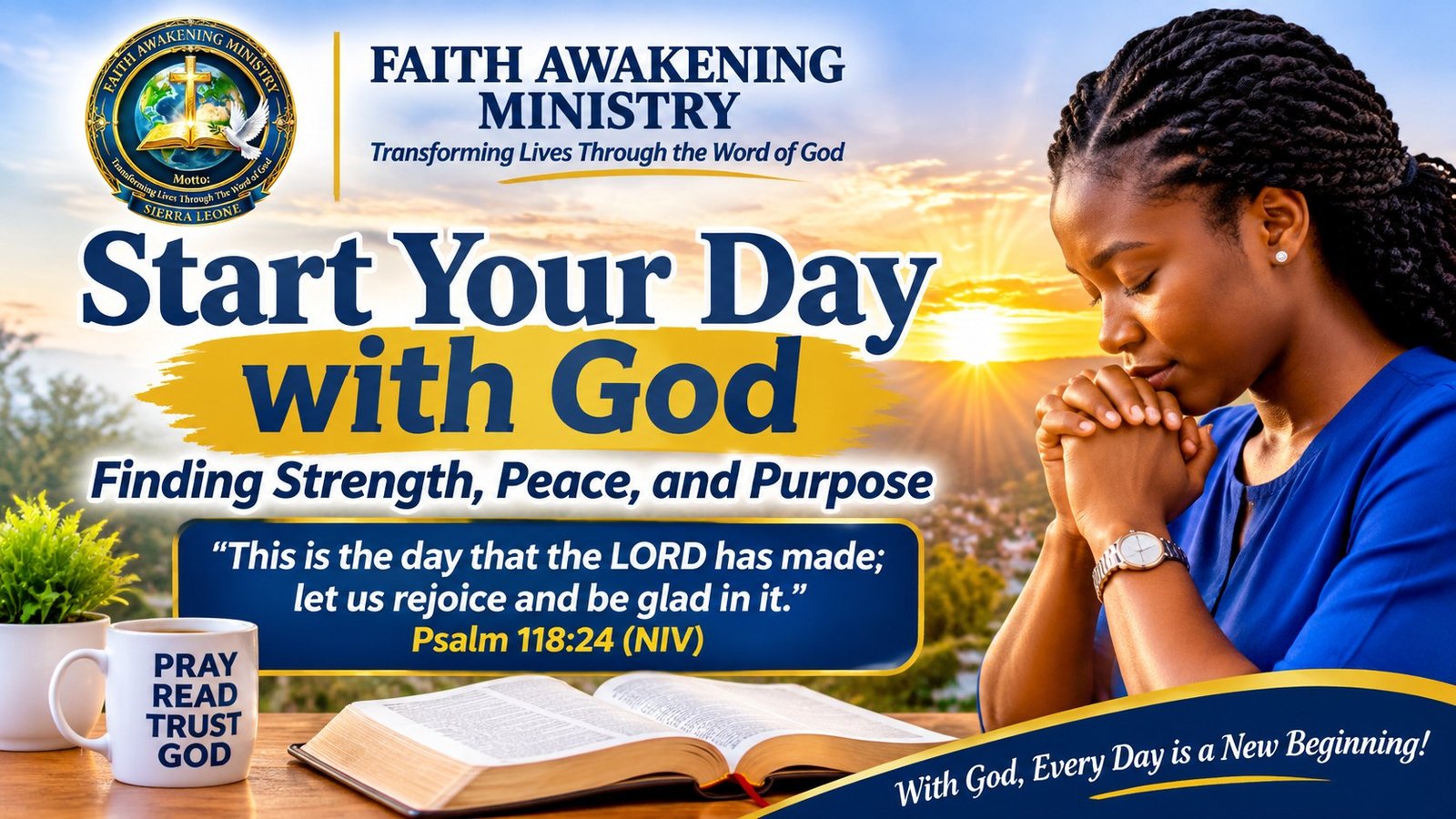
TRUSTING GOD IN UNCERTAIN TIMES: FINDING PEACE WHEN YOU DON'T KNOW WHAT TOMORROW HOLDS
Key Scripture: Proverbs 3:5–6 (KJV)
"Trust in the LORD with all thine heart; and lean not unto thine own understanding."
Introduction: When You Don't Know What Tomorrow Holds
Have you ever found yourself worrying about tomorrow?
Perhaps you are wondering how you will provide for your family.
Maybe you are waiting for an important answer, hoping for a new opportunity, or praying for a situation that seems to have no solution.
Sometimes, life becomes difficult not because we have stopped believing in God, but because we cannot understand what is happening around us.
We pray, but the answer does not come immediately.
We work hard, but the results are not what we expected.
We make plans, but circumstances change.
We try to remain strong, yet there are moments when uncertainty becomes overwhelming.
During these seasons, one important question arises:
Can I continue trusting God when I cannot see what He is doing?
The Bible teaches us that trusting God does not mean we understand every situation.
It means recognising that our understanding is limited while continuing to depend on His wisdom, faithfulness, and guidance.
Proverbs 3:5–6 encourages us to trust the Lord with all our hearts rather than depending entirely on our own understanding.
This is a powerful reminder for anyone facing uncertainty.
You may not know what tomorrow will bring, but you can still choose to walk with God today.
You may not have every answer, but you can continue seeking His wisdom.
You may be experiencing difficulties, but those difficulties do not mean that your life has lost its purpose.
Faith is not the absence of uncertainty. Faith is choosing to trust God while walking through uncertainty.
Today, let us discover how to remain faithful when the future is unclear.
1. Understand That Uncertainty Is Part of Human Life
Many people believe that if they have enough faith, everything in their lives should become predictable.
They assume that faithful Christians should never experience disappointment, financial challenges, family difficulties, or unanswered questions.
But the Bible presents a different picture.
Faithful people experienced situations they could not fully understand.
Abraham was called to leave his familiar surroundings and journey toward a land God would show him.
Joseph experienced betrayal, slavery, and imprisonment before eventually becoming a leader in Egypt.
David faced opposition and danger even after being anointed.
The disciples experienced storms, uncertainty, and situations that challenged their understanding.
These examples remind us that following God does not mean having complete control over every circumstance.
Sometimes, faith requires us to continue moving forward without knowing exactly how everything will happen.
This does not mean we should stop planning or become careless.
We should still make responsible decisions, seek advice, work diligently, and prepare for the future.
But we must recognise that our plans cannot eliminate every uncertainty.
There will be situations where we must trust God while doing the best we can with the information available.
Instead of asking only, "Why is everything uncertain?" we can also ask:
"Lord, what is the wise and faithful thing I can do today?"
That question can help us move from fear toward responsible action.
2. Remember That God Is Faithful Even When Circumstances Change
One of the greatest sources of encouragement for Christians is remembering God's faithfulness.
Circumstances may change.
People may disappoint us.
Opportunities may disappear.
But God's character does not become unreliable simply because our situation becomes difficult.
Lamentations 3:22–23 speaks about the Lord's mercies and faithfulness.
This passage reminds us that God's compassion is not exhausted by the difficulties we experience.
Consider the Israelites during their journey through the wilderness.
They had experienced deliverance from Egypt, but their journey involved unfamiliar circumstances, challenges, and moments of uncertainty.
They needed to learn to depend on God rather than assuming that every stage of their journey would be comfortable.
Their experience teaches us that faithfulness is often demonstrated through continued dependence on God.
When your circumstances change, remember the ways God has helped you in the past.
Think about the people who encouraged you.
Remember the lessons you learned during previous difficulties.
Recognise the opportunities you received and the strength you developed through challenging experiences.
These memories should not become a reason to ignore present problems.
Instead, they can remind you that difficult circumstances do not automatically mean that hope has disappeared.
God's faithfulness is a foundation for continuing to trust Him.
3. Do Not Allow Fear to Control Your Decisions
Uncertainty can produce fear.
Sometimes, we become so concerned about what might happen that we stop making responsible decisions.
We imagine every possible negative outcome.
We become afraid to try something new.
We hesitate to seek opportunities.
We may even avoid asking for help because we are embarrassed about our circumstances.
But fear should not become the foundation of our decisions.
In Isaiah 41:10, God encourages His people not to fear, reminding them of His presence and strength.
This passage does not mean that Christians will never experience fear.
It reminds us that fear does not have to determine our response.
For example, if you are experiencing financial difficulties, fear may tempt you to make desperate decisions.
Instead, take time to examine your situation carefully.
Review your expenses.
Consider realistic opportunities to improve your income.
Seek advice from trustworthy people.
Avoid decisions that could create greater problems simply because you feel pressured.
If you are facing a difficult family situation, do not allow fear to prevent you from having an honest and respectful conversation.
If you are searching for employment, continue preparing, applying, and improving your skills.
If you are waiting for an important answer, seek appropriate information rather than allowing assumptions to control your thoughts.
Faith should encourage wisdom, not replace it.
You can acknowledge your fears without allowing them to become the authority over your life.
4. Learn to Trust God One Day at a Time
Sometimes, uncertainty becomes overwhelming because we try to solve every future problem at once.
We think about next week, next month, next year, and every possible difficulty that might arise.
Before long, we become emotionally exhausted.
But Jesus teaches an important principle in Matthew 6:34:
"Take therefore no thought for the morrow: for the morrow shall take thought for the things of itself."
This teaching encourages us not to become consumed by tomorrow's worries.
It does not mean that we should ignore our responsibilities.
Planning for the future is important.
Saving money, preparing for work, caring for our families, and making responsible decisions are all valuable activities.
But there is a difference between preparing wisely and allowing worry to consume our lives.
You cannot solve every future problem today.
You can, however, take meaningful steps in the present.
You can complete the work in front of you.
You can communicate honestly with your family.
You can make a responsible financial decision.
You can pray for wisdom.
You can seek help when necessary.
You can continue learning and developing your abilities.
Sometimes, the best way to face uncertainty is to focus on the next faithful step rather than demanding complete knowledge of the entire journey.
Do what you can today.
Trust God with what you cannot control.
5. Continue Praying Even When the Answer Has Not Come
One of the most difficult experiences in Christian life is waiting for an answer to prayer.
You may have prayed about a situation for weeks, months, or even years.
You may have asked God for healing, provision, direction, reconciliation, or an opportunity.
Yet the situation remains unresolved.
During such moments, it is easy to become discouraged.
You may wonder whether your prayers matter.
You may feel that God has forgotten your situation.
But the Bible encourages believers to continue praying.
Philippians 4:6–7 teaches Christians to bring their concerns to God through prayer and supplication with thanksgiving.
The passage also speaks about the peace of God guarding our hearts and minds through Christ Jesus.
This is an important reminder.
Prayer does not always mean that every circumstance changes immediately.
Sometimes, prayer helps us express our concerns honestly, seek wisdom, and develop a more peaceful response to difficult situations.
When you pray, do not feel that you must hide your struggles from God.
You can tell Him what worries you.
You can ask for guidance.
You can pray for the people involved.
You can seek strength to make responsible decisions.
You can ask for help in understanding what you should do next.
And when you do not know what to say, you can begin with a simple prayer:
"Lord, please guide me through this situation. Help me to trust You and make wise decisions."
Prayer is not a performance.
It is an opportunity to bring your heart before God.
6. Take Responsible Action While Trusting God
Trusting God does not mean sitting down and waiting for everything to happen automatically.
Faith and responsible action should work together.
Consider someone who is praying for employment.
That person can continue praying while also preparing a CV, searching for opportunities, developing skills, and contacting appropriate employers.
Consider someone who wants to improve their financial situation.
They can pray for wisdom while reviewing expenses, managing resources carefully, and exploring realistic income opportunities.
Consider someone who is experiencing difficulties in a relationship.
They can pray while also communicating honestly, seeking wise counsel, and establishing appropriate boundaries.
Consider someone who wants to grow spiritually.
They can pray while reading Scripture, practising what they learn, and participating in healthy Christian fellowship.
James 2:17 teaches that faith without works is dead.
This reminds us that genuine faith should influence how we live.
We should not use prayer as an excuse to avoid responsibilities.
Instead, prayer should encourage us to approach our responsibilities with wisdom, humility, and courage.
You may not control the final outcome.
But you can take responsibility for the decisions that are within your control.
7. Remember That Your Present Situation Does Not Define Your Entire Future
Sometimes, a difficult season can make us believe that our entire future will remain the same.
A person who experiences financial hardship may begin believing that they will never improve their circumstances.
Someone who experiences rejection may conclude that they will never find meaningful opportunities.
A person who has experienced disappointment may begin believing that hope is no longer possible.
But our present circumstances do not provide complete information about everything that may happen in the future.
The Bible contains many examples of people whose lives changed in unexpected ways.
Joseph experienced years of difficulty before his circumstances changed.
Ruth experienced loss before beginning a new chapter of her life.
David experienced opposition before becoming king.
These stories should not be used to promise that every difficult situation will end exactly as we desire.
Instead, they remind us that our understanding of the future is limited.
We should not assume that today's difficulties have the final word.
Continue developing your abilities.
Continue making responsible decisions.
Continue seeking wisdom.
Continue building healthy relationships.
Continue trusting God.
Your life still has opportunities for growth, learning, service, and meaningful contribution.
8. Protect Your Peace by Focusing on What You Can Control
When life becomes uncertain, we sometimes spend too much time trying to control things that are beyond our influence.
We worry about what other people think.
We become anxious about decisions that have already been made.
We repeatedly imagine situations that may never happen.
We allow every piece of negative information to affect our emotional state.
But constant worry does not automatically produce wisdom.
Instead, it can distract us from the responsibilities we need to address.
Psalm 46:10 encourages people to be still and recognise God.
This can remind us to slow down and reflect rather than reacting to every situation with fear.
Practically, you can begin by identifying the things you can control.
You can control whether you seek accurate information.
You can control whether you treat people respectfully.
You can control whether you continue learning.
You can control whether you take responsible action.
You can control whether you make time for prayer and reflection.
You cannot control every decision another person makes.
You cannot guarantee every opportunity will succeed.
You cannot predict every future circumstance.
Recognising this difference can help you direct your energy toward meaningful action.
Sometimes, peace begins when we stop demanding control over everything and start taking responsibility for what is actually ours to do.
A Practical Challenge for Today
Take a few moments to practise these five steps.
1. Identify your greatest concern.
Write down the situation that is currently creating uncertainty in your life.
2. Separate facts from fears.
Ask yourself what you know for certain and what you are only imagining might happen.
3. Pray for wisdom.
Bring your concerns before God and ask for guidance, strength, and peace.
4. Take one responsible action.
Identify a practical step you can take today to address the situation.
5. Release what you cannot control.
Recognise that some outcomes are beyond your influence. Continue doing what is right without allowing worry to consume your life.
You do not need to solve everything today.
Begin with one faithful step.
Conclusion: Trust God With Tomorrow While Being Faithful Today
Dear reader, uncertainty is part of life.
There will be moments when you do not know what tomorrow holds.
There will be situations that challenge your understanding.
There will be prayers whose answers take longer than you expected.
There will be decisions that require courage, patience, and wisdom.
But you do not have to face these situations without hope.
God's Word encourages us to trust Him, seek His wisdom, and remain faithful.
Trusting God does not mean ignoring problems.
It means facing them with faith, prayer, responsible action, and the willingness to learn.
If you are experiencing financial difficulties, continue seeking wise solutions.
If you are facing family challenges, pursue honest communication and appropriate support.
If you are waiting for an opportunity, continue preparing yourself.
If you are struggling emotionally, reach out to someone trustworthy rather than carrying every burden alone.
And if you are uncertain about the future, remember that you can still make meaningful decisions today.
You may not know everything about tomorrow, but you can trust God while faithfully doing what is right today.
Let your faith become stronger than your fear.
Let prayer become part of your response to uncertainty.
Let wisdom guide your decisions.
And let hope remind you that your present circumstances do not define the whole story of your life.
May the Lord strengthen your heart, guide your steps, and give you peace as you continue trusting Him.
LET US PRAY
Heavenly Father,
Thank You for Your love, mercy, and faithfulness.
You know every concern that is in my heart.
You know the situations I do not understand, the challenges I am facing, and the questions I have about tomorrow.
Please forgive me for the times I have allowed fear and worry to control my thoughts.
Teach me to trust You with all my heart.
Give me wisdom to make responsible decisions and courage to take the steps that are necessary.
Help me distinguish between what I can control and what I must release into Your hands.
When I become discouraged, remind me of Your faithfulness.
When I feel uncertain, guide me through Your Word.
When I face difficult decisions, give me understanding and patience.
When I experience financial challenges, help me manage my resources wisely and recognise appropriate opportunities.
When my heart becomes troubled, help me seek peace through prayer and trustworthy support.
Strengthen those who are facing difficult seasons.
Encourage those who are waiting for answers.
Comfort those who are experiencing disappointment.
Give hope to those who feel that their future is uncertain.
Help us to remain faithful, compassionate, and responsible in every situation.
May our lives reflect trust in You, and may our decisions be guided by wisdom and love.
In the mighty name of Jesus Christ, we pray.
Amen.
SHARE THIS MESSAGE
If today's message has encouraged you, share it with someone who is facing uncertainty or struggling to find peace.
Remind them that they do not have to understand every situation before taking the next faithful step.
Let us encourage one another to trust God, seek wisdom, and remain hopeful through every season of life.
Transforming Lives Through the Word of God.